COUNTER.POINT. Sarpi. & the unit of intervention.
a note from a discussion on the housekeeping of a successful area.
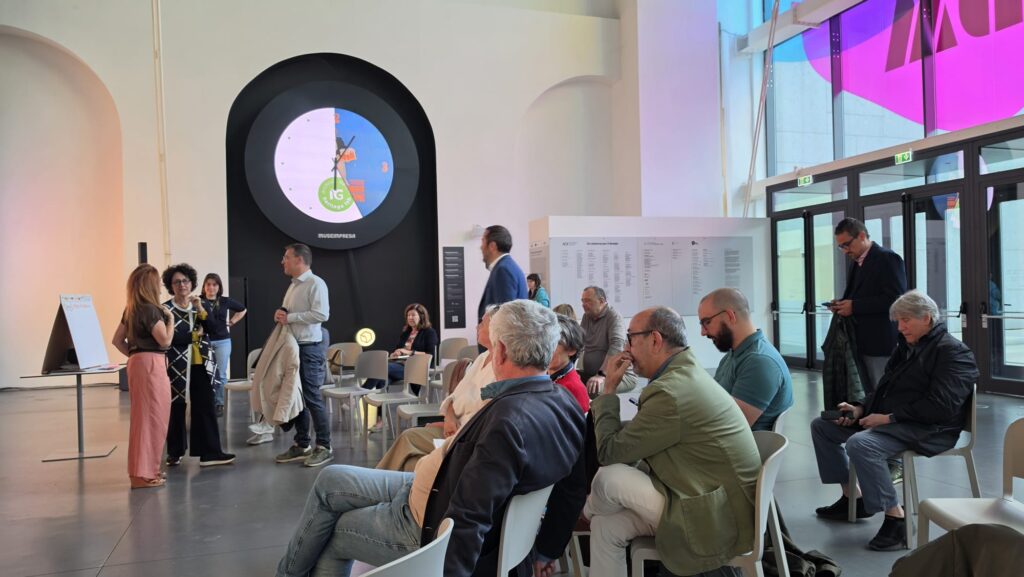
On 13 May, the ADI Design Museum hosted ‘Sarpi Make the Difference’, a discussion among stakeholders about a pressing question: how to improve housekeeping and waste collection on one of Milan’s busiest commercial streets.
The discussion offered an opportunity to integrate observations from work we have been developing since 2022, in which Chinatowns serve as a recurring lens rather than a topic in themselves. That inquiry expanded in AP4 | to Build. a World. with contributions from operators and cultural practitioners in Bangkok, Singapore, and Milan, and continues in a different platform work.
Chinatowns appear in our research as laboratories for cultural integration and business model innovation. They hold, in concentrated form, questions that people-facing industries grapple with across most markets: how a place is composed, how operators sustain agency, how heritage and change negotiate within a single street, and how differently interested populations share the same square meters without sharing the same stakes.
The questions, however, are not unique to Chinatowns. Across many European cities, the co-presence of residents, operators, and increasingly intense tourist flows has put pressure on the basic housekeeping of successful areas — cleanliness, decorum, liveability — and on the relationships that hold those places together. Various solutions have been attempted, most of them imposed from above. Across these attempts, what we consistently find absent is the question that organizes this counterpoint — and the Chinatown research more broadly — which is one of agency.
By agency, we do not mean consultation, consent, or being asked.
We mean the capacity to participate in shaping a place from one’s own ground: one’s own working day, one’s own scale, one’s own resources. A street works when each party operating on it has agency in this sense, while it risks to fragments when one party’s agency is presumed or another’s is reduced to compliance.
What follows is offered as a continuation of the conversation opened at the workshop on 13 May, rather than as a verdict on it.
Sarpi origins are not those of a typical Chinatown. Historically — in Bangkok, in Singapore, in Yokohama, and in the early-twentieth-century Chinatowns of San Francisco and New York — the shop owner was also a resident of the street. A single ecosystem: the shop on the ground floor, the family on the upper floor or in the cellar behind it, and the trade out the front door. The operator was both the resident and the cultural carrier. That triple identity gave the historical Chinatown its coherence and resilience. Governance interventions could lean on “community” as a real, located thing because the people who carried on the commerce were also the people who slept on the street.
Sarpi is different, and the difference is structural.
The commercial transformation of Via Paolo Sarpi occurred gradually, with multiple waves of takeovers starting in the late 1980s and intensifying during the 1990s. Italian shop owners and retirees gradually transferred their businesses to Chinese operators, in contrast to the typical pattern in other Chinatowns, where founding families are now passing properties to outsiders.
Successive municipal administrations’ relocations of wholesale businesses altered the commercial fabric, though not always as intended. Today, the commercial layer of Sarpi is overwhelmingly Chinese, but the operators commute in. They are not residents. The residential community of Sarpi is mostly Italian, long-standing, and attached to the neighborhood in the way residents are.
Today, the person managing the shop is not the resident living above it. The resident strolling down the street isn’t necessarily the visitor coming for weekend food. Likewise, the visitor — whether domestic or international — isn’t the same person responsible for cleaning up afterward.
This is the key factual point to consider when intervening on Sarpi. Discussions frequently assume a unified community of operators, residents, and carriers, but such unity does not exist here. Instead, there is an ecosystem comprising three parties with differing interests.
A reconsideration of the intervention unit might be usefull. When stakeholders gather to discuss a commercial street, their perspectives shape what they notice. A top-down approach — which presents best practices and suggested behaviors — assumes that a lack of knowledge is the main issue. The underlying belief is that if operators understood the problem better, they would change their actions. By clearly presenting the problem and sharing successful solutions from other contexts, desired behaviours are expected to follow.
On a street like Sarpi, however, the main challenge may not be a lack of awareness. Operators likely understand that waste is an issue because they handle it daily. The real limitation is capacity: constrained staffing, working hours that often prevent attendance at workshops, supply chains outside the operator’s control, and the accumulated distance—linguistic, cultural, operational—between an institutional framework and the needs of running a store.
Interventions designed from an ‘educational’ perspective tend to focus on tasks that exceed what operators can absorb. The solution requires the operator to do something that, even with full understanding and goodwill, falls outside the operational ceiling for the day.
Recent research shows this ‘issue with posture’ occurs across various fields. Bassam Jabry in AP5 | WELL. describes two main approaches: one in which the designer acts as a guru with all the answers, and another in which the designer acts as an empathic explorer, listening and learning before acting. The guru approach yields impressive-sounding proposals that often fail in implementation, a phenomenon Jabry calls ‘design creep,’ highlighting the gap between the envisioned project and its real-world performance. Conversely, the empathic approach starts with research and prototyping that consider the actual conditions where the intervention will be applied.
The approach is similar to the work of Jennifer Fauster, Cecilia Furlan, and Emilie Stecher on Alpine territories for the Venice 2025 Architecture Biennale. Their thinking is fundamentally structural, shifting focus from objects to relationships, and from individual artifacts to interaction systems. Projects labeled as sustainable can still be extractive if they don’t consider the networks they reshape. Their proposed alternative includes cooperative governance, stewardship, shared infrastructure, and reversibility as a core design principle—concepts that, in landscape terms, exemplify the attitude needed for a commercial street like Sarpi.
Contemporary design thinking increasingly recognizes that imposing a rigid form on a complex system often leads to unstable outcomes. Effective intervention involves engaging with the assemblage — balancing forces, redistributing stresses, and embracing reversibility — yielding more durable outcomes.
Sarpi is not the only location where this posture mismatch is evident. The Fuorisalone — Milan’s extensive program of exhibitions and events during Design Week, attracting around half a million people — has faced similar criticism in recent years. The Fuorisalone’s editorial team, reflecting on the 2026 edition, explicitly posed the question: “is it the model of the event under discussion, or the way in which we live it?” — a question that, in different words, highlights the same core issue of composition that is central to the Sarpi discussion.
Different scales and time horizons raise the same fundamental question: how to address the multi-stakeholder reality, whose scale, density, and economic complexity have exceeded the capacity of existing institutional frameworks.
From this perspective, reading a street like Sarpi through the lens of an operator’s daily work isn’t merely academic. It requires practical, hands-on knowledge of running shops, managing staff, negotiating with suppliers, and planning logistics within manpower constraints. Without this foundation, an operator’s constraints go unseen, leading to interventions misaligned in scale. The key missing element in many well-meaning efforts isn’t consultation but the analyst’s prior experience managing a business under the same conditions the intervention aims to alter.
When these interventions don’t succeed, the lack of impact is often attributed to cultural distance. Statements like “The F&B operators did not engage. The Chinese operators did not understand and are difficult to reach” are common. This viewpoint is appealing because it shifts the focus from the design’s shortcomings to the operator’s characteristics, maintaining the original framework.
More frequently, the issue arises from design distance. The intervention might have been improperly scaled for the operator’s typical workday from the beginning. While cultural distance is genuine, it is usually the explanation given after a design-distance failure, rather than its actual cause.
In this scenario, it might be helpful to emphasize composition rather than traditional ‘education’. When three groups with different interests share a street, the real challenge isn’t about what to teach them but how to unite them. Composition doesn’t imply one side holds knowledge that others need to acquire. Instead, it acknowledges that each party already has something valuable to contribute, and it focuses on creating conditions that allow everyone to share their part.
What sets a cohesive place apart from one that fragments is the question of whether each party feels they have enough agency to want to participate.
RESIDENTS. Residents in Sarpi possess agency: they have a voice and a genuine connection to the street that isn’t purely transactional. They safeguard their home investments and intend to maintain their quality of life. Engagement occurs through neighborhood committees, the parish, and shared responsibilities for communal spaces. The challenge on the residential side isn’t a lack of agency but the common assumption that residents’ agency represents the entire street’s agency.
OPERATORS. Shop owners encounter operational challenges like limited hours, staffing issues, language barriers, and supply chain disruptions—factors outside their control. To gain real agency, they need solutions such as logistics partners designed for small teams, financial incentives to offset compliance expenses, and a community of peers – who hopefully meet at business-convenient times – who already adopted changes supporting a better stewardship of the street and can share practical experiences and successful strategies.
VISITORS. Visitors make choices: whether to visit, spend, or leave. We should always be grateful to have vistors to our cities and communities. The goal of composition is to facilitate their participation. Other cultural districts have achieved this through small interventions, such as guiding—rather than commanding—signage, offering incentives, and using wayfinding to disperse visitor flow rather than concentrate it.
A composition of these parts of the overall Sarpi constituency would serve as a valuable foundation for targeted intervention.
In all of this, it is important to remember that SARPI is a powerhouse. Beyond its commercial achievements, it represents an area rich in integration and tradition, embodying tangible culture.
The street functions as a small-scale reflection of the city, requiring it to operate as a cohesive ecosystem. It calls for a clear, unified voice—an agency capable of effectively working with municipal authorities at various operational levels. Rather than several overlapping groups, a single organization—perhaps a re-incarnation of the Sarpi Association—that brings together diverse expertise and perspectives, engaging all stakeholders and forming dedicated committees for security, safety, cleanliness, and wayfinding, could better represent the street’s intricate nature.
In a typical ‘Chinatown Association’ model, a small association fee could cover navigation tools, shared services, and street-level coordination, which the current system may not always support. Finally, in a city renowned for design, with a street housing a nearby design museum, it could contribute to commissioning an appropriate and effective street graphics system.
Places like Sarpi are standalone entities that require innovative, open, and practical strategies. More broadly, they represent a gift to a city whose extended constituency – locals and visitors – increasingly values uniqueness. The issues they raise involve not only cultural diversity but also the broader challenge of managing evolving business models and cultural references that traditional institutional structures may not be equipped / have capacity to handle.
Large-scale top-down efforts on either front are likely to fail for these reasons.
With thanks to the organisers and participants of Sarpi Make the Difference on 13 May.
#sarpichinatown #peoplefacingbusiness #hospitality #milano #viapaolosarpi
FURTHER READING.
- Streetgood — Ascolto Attivo. The participatory framework within which Sarpi Make the Difference (13 May 2026) sat, addressing waste management in NoLo, Sarpi, and Isola from December 2025 through June 2026. ascoltoattivo.net/progetti/streetgood
- Gambero Rosso, December 2024. “Qualcuno salvi via Paolo Sarpi a Milano. Ascesa e declino della Chinatown milanese” — on the foodification of the street and its consequences. gamberorosso.it
- Geolitterae, University of Milan, June 2025. “Chinatown: la trasformazione urbana e sociale del quartiere milanese” — an interview-based study on Sarpi’s transformation, including reflection on gentrification through food. geolitterae.unimi.it
- Il Giorno, January 2024. “Le mille vite di Paolo Sarpi: dai carretti allo street food, la movida ora è a Chinatown” — a journalistic portrait of the street’s most recent transition.
- AP4. To Build a World| Outside-In. The opening of our Chinatown research, with sections on Yaowarat (Bangkok), Niu Che Shui (Singapore), and Paolo Sarpi (Milan).